How to Succeed on YouTube
Hitfactor is built for a specific style of YouTube content: scripted, educational videos that deliver value. By value, we mean content that solves a viewer’s problem or changes their behavior in a way that benefits them. This might be different than content you’ve made in the past.
Below are the guiding principles we follow for all videos:
Embrace the algorithm
Section titled “Embrace the algorithm”Over 70% of views on YouTube come from algorithm recommendations. The algorithm is simple: it optimizes for viewer enjoyment. Its only job is to put videos in front of viewers that they want to watch. The more they watch, the more money YouTube makes from ad revenue.
This means that:
- Viewers are naturally incentivized to watch videos they like.
- YouTube is incentivized to show them those videos.
- All you have to do is align with the two: make videos viewers want to watch.
What do viewers want?
- Their problems solved
- Their lives made easier
- Money made / saved
- Time saved
- Real humans with credibility (the AI avatar early results are not good)
Don’t confuse what viewers want with pure entertainment. These motivations can be stronger than entertainment.
That’s it. That’s the big secret. Everything in Hitfactor is built to help you make these videos.
Forget about SEO
Section titled “Forget about SEO”Here are the facts:
- YouTube says Search accounts for at most 15% of views. In our experience, most channels are below 10%.
- Google disclosed in litigation that only about 1% of YouTube views come from Google Search.
- Every channel we’ve seen take off search has never been a driver.
- Semantic search is here (and has been for a while). The search engines (and AEO/GEO) understand the meaning of your content. You don’t need to worry about keyword targeting.
The short version: optimizing for it won’t drive views and if you make good content you’ll get search traffic for free.
Solve a problem or change behavior
Section titled “Solve a problem or change behavior”In a low-trust environment, the best way to earn trust and keep viewers coming back is to:
- Solve a problem they have, or
- Change a behavior that benefits them.
Decades of persuasion and behavioral research point the same direction: people return to what serves their self-interest, the “what’s in it for me” that marketers and psychologists have tested for years. They don’t come back for the video. They come back for what it does for them: a problem gone, or a habit that now works better.
Speak to your viewer’s level of awareness
Section titled “Speak to your viewer’s level of awareness”Every viewer can be placed at one of five levels of awareness:
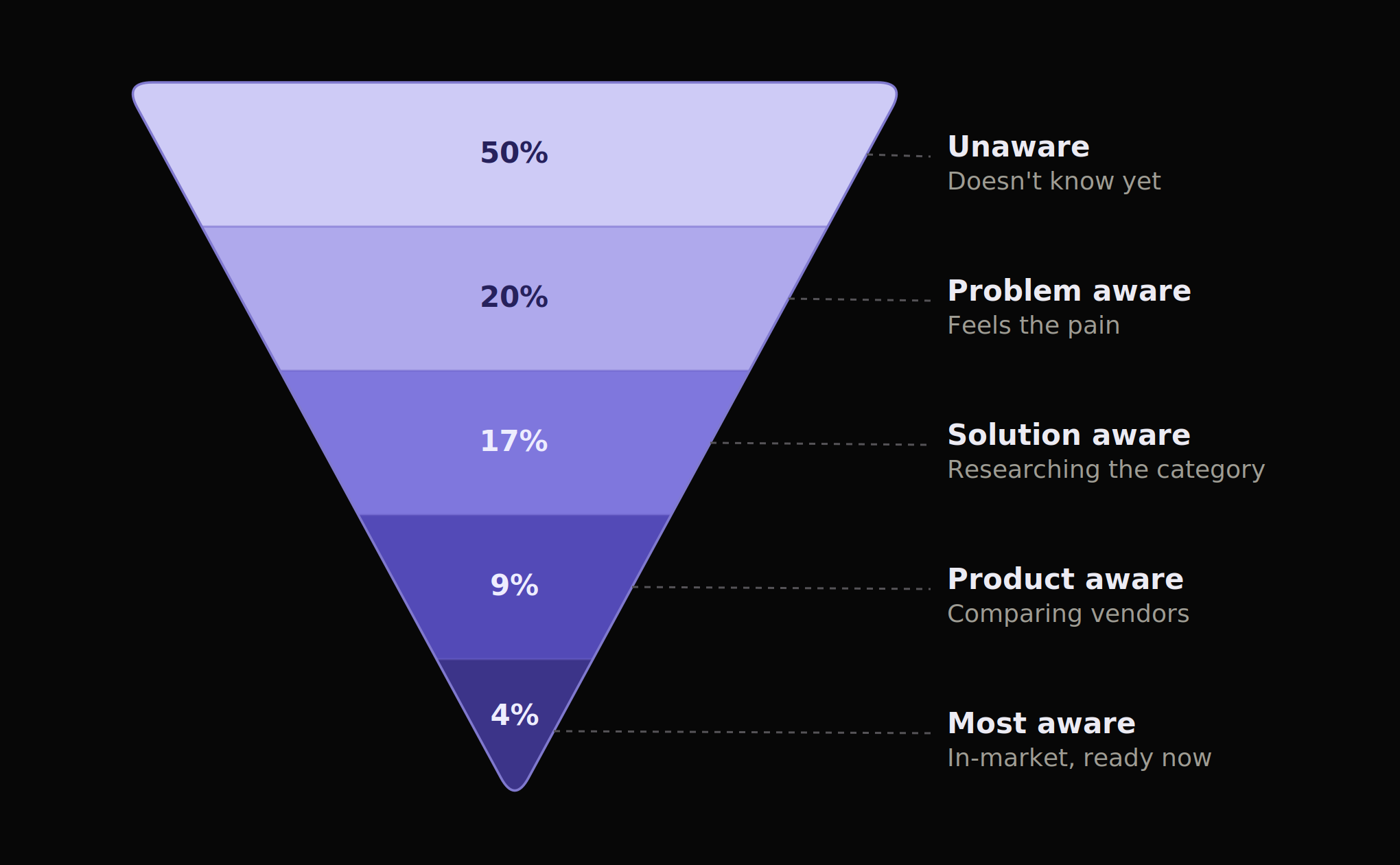
Most YouTube channels don’t grow because the content targets most aware or product aware. By definition those are the smallest groups. The most effective way to grow an audience is to target the lower levels of awareness.
Hitfactor is built to steer your content toward these lower levels of awareness.
Your product is background
Section titled “Your product is background”Viewers are highly suspicious of sales pitches. The lower their Level of Awareness, the more impatient they will be with presenters pushing their product. Retention on YouTube is already a brutal game. Pitching your product from the beginning is a sure fire way to send your retention even lower.
The best way to avoid this is to solve a problem the viewer has while using your product, service, or brand as the background.
Talk to one person
Section titled “Talk to one person”The best way to connect with an audience is to speak like you would to a friend across the table. Each viewer watches a video individually. Avoid speaking to “everyone,” or “you all.” You’re talking to one person, not a crowd. This makes your presentation more natural, removes the pressure of presenting to an entire audience, and connects with the viewer.
Assume a cold audience
Section titled “Assume a cold audience”At the same time, assume that the one person on the other side of the camera doesn’t know anything about you. Your hook or intro must establish enough credibility for the viewer to trust the promise. That can be a direct Proof statement, a demonstrated result, precise subject-matter knowledge, or the content itself. For example: “I’m Matt, I did $5 million in revenue and 7 million views for one product channel and now I’m building Hitfactor.”
The purpose of YouTube is to build your audience. Statistically, most people do not know who you are or why they should listen to you. Even “famous” channels with millions of subscribers stick to this principle. If you are Elon Musk or Taylor Swift you can skip this step.
YouTube is your 24/7 sales & marketing team
Section titled “YouTube is your 24/7 sales & marketing team”Think of the algorithm as your 24/7 sales and marketing team: it looks at what viewers want to watch, if your video looks like a good fit it puts the video in front of them. It’s like a team cold-calling prospects, knocking on doors 365 days a year until it finds the right person. For free.
Every video you publish is an asset that can reach viewers for years. We have seen videos sit dormant for 18 months, then find an audience and drive significant views and revenue.
Be patient
Section titled “Be patient”We’d love to promise you millions of views in days. But that would be dishonest. YouTube is an extremely competitive platform and viewers are easily distracted.
- 10% of people clicking on your video is exceptional. In other words, if 9 out of 10 people skip your video you are doing a great job.
- The best videos in the world still lose than half the audience within the first 30 seconds.
Hitfactor is built to make publishing videos simple and easy. The result is you can publish a video each week for months or years. The effect comes from the accumulation of that content library.