Does the "I Asked AI to Make Me Money" Outlier Format Actually Work?
A viral post says steal this format and you'll go viral. We found all 97 videos that used it. Most got almost no views.
There’s a popular idea in the YouTube-growth world called an “outlier format”: a video template that supposedly delivers way above a channel’s normal views. The advice is:
- Find an outlier format,
- Copy it,
- Go viral.
This recent LinkedIn post is a prime example. Four YouTube channels all made the same video: “I Asked Claude To Make Me As Much Money As Possible.” And next to each is a big number: this video got 15 times the channel’s normal views. 5 times. 12 times. The takeaway being sold is simple: steal the format, make this video, and you’ll go viral too.
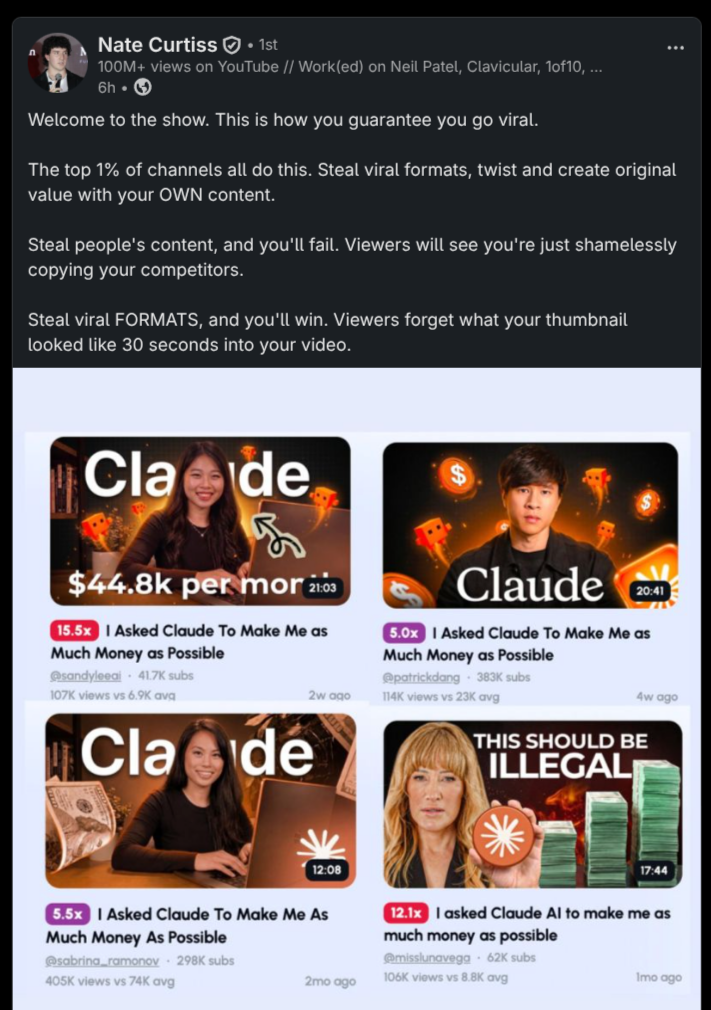
We took the claim at its word and gathered a broad sample of the format. We found every video we could that used it, not just the four winners someone picked, with the goal of seeing whether this “outlier format” describes the typical result or just the highlight reel. (We searched YouTube exhaustively, but a search engine ranks by popularity and hides the lowest-view results, so think of this as a wide net, not a literal headcount of every video ever posted. If anything, the videos hardest to find are the flops, which means the real picture is, if anything, worse than what we show.)
The four in the screenshot are real. They’re also the very top of a pile, and most of the pile got almost nothing.
Across 81 of these videos we could measure, the middle one got about 1.4x its channel's usual views. Fewer than half even doubled it, and only about 1 in 6 hit the 10x the screenshot advertises.
The 5x–15x videos in the post are real, but they're the top sliver. For most makers, this video did NOT produce a hit.
What we did
Section titled “What we did”This study works differently from our others, and we want to be upfront about it.
Our usual studies pick a question first, write the plan down, lock it, and only then look at the data. This one started from a screenshot we’d already seen. So we’re not claiming a sealed prediction here. Instead, the job is honest in a different way: take the format those four winners came from, find the whole population, and show you what’s really in it.
We searched YouTube for every version of this video we could find, across every AI tool people plug into it (Claude, ChatGPT, Gemini, Grok, and more). We found 97 of them, across 85 channels. Then we measured how each one actually did against the channel that made it.
We could do that because everything here is public. Anyone can type the title into YouTube and see these videos and their view counts. So unlike our other studies, this one names the actual videos.
The one fair way to score a video is against the channel that made it. A million-view video on a million-subscriber channel isn’t impressive; a 50,000-view video on a channel that usually gets 3,000 is. So for each of these videos, we compared it to that same channel’s normal videos from the months before. Did it beat what the channel was already doing, or not?
One thing we deliberately did not do: judge the videos. We took the format at face value: the title and the thumbnail and the basic concept. Then we counted a video as “the format” if it looked like the thing being copied from the outside. We did not watch all 97 and rate how good the script was, how well it was edited, or whether the creator actually delivered. That’s on purpose. The pitch we’re testing is “copy the title, copy the thumbnail, copy the concept, and that’s the move”: the surface, not the substance. So we measured the surface, exactly as it’s sold. If the real lesson turns out to be “the format only works if the content underneath it is also great,” that’s not a copy-the-format strategy anymore. That’s just “make a great video,” which was always true and isn’t what anyone is selling.
Real, but not reliable: two different things
Section titled “Real, but not reliable: two different things”Before the findings, one idea this whole study turns on: “the format works sometimes” and “the format is reliable” are not the same claim.
A slot machine “works.” Somebody wins. That doesn’t make pulling the lever a reliable way to get rich. The question a creator actually faces isn’t “can this video ever go big?” (yes, obviously, four of them did). It’s “if I make this video, what happens to me, typically?”
That’s why we lead with the middle of the pile, not the top. The screenshot shows you four winners. We’re going to show you all 97.
Finding 1 — Most of these videos barely beat the channel’s normal video
Section titled “Finding 1 — Most of these videos barely beat the channel’s normal video”Of the 81 videos we could score against their own channel:
- The middle one got about 1.4x the channel’s usual views. A small bump, not a breakout. And our sample is small enough that we can’t even be sure the typical video beats normal at all.
- 41% did worse than the channel’s own average video. Making this video was as likely to underperform the channel’s normal upload as it was to even double it.
- Only 16% hit 10x or more, the kind of number the screenshot advertises (and with a sample this size, that’s somewhere between roughly 1-in-10 and 1-in-4).
The biggest single bar is “did worse than the channel’s normal video.” We stress-tested it: requiring at least 1, then 5, then 20 prior videos of baseline; comparing against a 2-, 6-, 12-month, or all-time stretch of the channel’s past; and counting one result per channel instead of one per video. The 1.4x middle held every way. It’s not an artifact of shaky math on tiny channels.
And we used a friendlier yardstick than the screenshot does. Its tool grades against the channel average (“their channel average”). We grade against the median, a gentler bar, since a few past hits pull an average up. Scored the screenshot’s way, the typical attempt is about 0.8x: below the channel’s own average, with a clear majority underperforming. So on the exact metric the format is sold with, the median attempt is a net loss. We led with the kinder number anyway, and it’s still just an ordinary video.
So does it fail more than it works? For any meaningful version of “works,” yes. Set the bar at “a real hit,” doubling the channel’s usual, and about 6 in 10 of these videos miss it. Set it at the 10x the screenshot sells and more than 8 in 10 miss. The only way the format “works more than it fails” is if you count barely edging the channel’s own average as a win, which is not the result anyone is being sold.
The middle attempt is ordinary
Across the 81 videos we could measure, the middle one got about 1.4x its channel’s usual views. Half did better than that, half worse. And 41% landed below the channel’s own average. The typical result is “a normal video,” not “a breakout.”
The winners are a thin top slice
Only about 16% of these videos hit 10x or more. Those are the ones that get screenshotted and sold back to you as the rule. They’re the exception, not the pattern.
A better slot machine is still a slot machine
On these same channels, a random video hits 10x about 1 in 21 times (4.7%). This format hits 10x about 16% of the time, or roughly three to four times more often. So the format genuinely improves your odds. But better odds on a slot machine is still a slot machine: more than 8 in 10 times, you don’t get the 10x.
On a channel with no audience, it did nothing
15 small channels used this exact format as one of their first videos. Every single one got between 1 and 87 views. Copying the format didn’t create an audience out of nothing.
Finding 2 — It’s a better slot machine. It’s still a slot machine.
Section titled “Finding 2 — It’s a better slot machine. It’s still a slot machine.”Here’s the fair credit. We measured how often any video on these same channels suddenly does 10x its normal, using the exact same yardstick we used on the format: every non-format video these 85 channels posted, scored the same way. The answer: about 4.7% of the time, roughly 1 in 21. That’s the background rate of a video popping on exactly this kind of channel.
This format hits 10x about 16% of the time, or about three to four times that background rate. So this is not nothing. The format genuinely improves your odds. (We compare against these same channels on purpose: money/AI/hustle channels run hotter than YouTube as a whole, so measuring the format’s lift against their own background rate is the fair test. Against YouTube at large the background rate is lower still, around 1 in 28, so the lift only looks bigger if you pick the easier comparison.)
But think about what that actually is: a slot machine with better-than-average odds is still a slot machine. Copying the format is like finding a machine that pays out a bit more often than the one next to it: you’ve improved your chances, but you’re still pulling a lever and hoping. More than five out of six times you don’t get the breakout, and four out of ten times you do worse than your channel’s own average. The edge is real. It’s still a gamble.
The bigger the win you’re chasing, the bigger the edge
Section titled “The bigger the win you’re chasing, the bigger the edge”Here’s the telling part. The format’s advantage isn’t spread evenly. It barely moves the common outcome and mostly moves the rare one:
| Beat the channel by… | Format videos | A normal video on these channels | Format’s edge |
|---|---|---|---|
| 2x | 42% | 25% | 1.7x |
| 3x | 38% | 17% | 2.2x |
| 5x | 25% | 10% | 2.5x |
| 10x | 16% | 4.7% | 3.5x |
| 20x | 9% | 2.0% | 4.4x |
Read down the last column: at the low bar (just doubling) the format barely helps, only about 1.7x more likely than a normal video. The edge keeps climbing the rarer the win, up to ~4.4x at 20x. So what the format actually buys you is jackpot odds, not a better typical video. That’s the slot machine in one table: it doesn’t make your everyday upload do better, it slightly improves your shot at the rare big payout. And as Finding 2.5 shows, even that payout might be small.
Finding 2.5 — Even when you win, you might win nothing
Section titled “Finding 2.5 — Even when you win, you might win nothing”Even a jackpot here might be worth nothing. One channel got a 55x on this format and walked away with 7,000 views. Another got a 15x and got 15 views. A big multiple is not a big payout: the multiple only says “better than this channel’s usual,” and this channel’s usual might be tiny.
So the question we’ll leave you with is the only one that matters, and it’s yours to answer: what are 7,000 views worth to you? Every video costs time and money to make. Is a rare breakout, at the real view count your channel would get, worth the stack of normal videos you’d make chasing it? We can’t run that math for you. We’re just saying it’s the math to run.
Finding 3 — On a channel with no audience, the format did nothing at all
Section titled “Finding 3 — On a channel with no audience, the format did nothing at all”The strongest version of the sales pitch is “this will blow up your channel.” So we looked at the channels that had no audience yet: 15 channels under 5,000 subscribers that used this exact format as one of their first videos.
Every one of them got between 1 and 87 views. Here are the ones at the bottom. Each links to the actual video, so you can see for yourself:
| Views | Subscribers | Channel | Title (opens on YouTube) |
|---|---|---|---|
| 1 | 2 | Mind Of Money | I Gave Myself 30 Days to Make $1,000 With AI… |
| 2 | 1 | AI Profit Lab | I Asked AI to Make Me Money… |
| 4 | 2 | Tech Whisperer | I Asked ChatGPT to Make Me Money… Here’s What Happened |
| 6 | 0 | thebroke bot | I Asked ChatGPT to Make Me Money (Here’s What Happened) |
| 13 | 3 | me and AI | I Asked ChatGPT to Make Me Rich… |
Same title, same idea, one to thirteen views. The channels that had no audience got almost no views. The format didn’t hand them one. Whatever lift the winning channels saw, it landed on channels that already had viewers to reach.
Finding 4 — The same creator usually can’t hit twice
Section titled “Finding 4 — The same creator usually can’t hit twice”If the format were a real lever, the people who pulled it and won would pull it again and win again. So we found every channel that made this video more than once: same creator, same format, multiple tries. Nine channels did. Here’s what happened across their attempts:
| Channel | Attempt 1 | Attempt 2 | Attempt 3 | Attempt 4 |
|---|---|---|---|---|
| Sandy Lee AI | 15.2x | 1.3x | ||
| Arlan Hamilton | 38.0x | 0.9x | 5.2x | |
| Chris Koerner | 2.9x | 1.2x | ||
| Sabrina Ramonov | 6.5x | 15.5x | ||
| Handmade & Beyond | 1.5x | 3.4x | ||
| Baddie In Business | 0.8x | 1.1x | ||
| Dhaval Kataria | 0.3x | 0.4x | ||
| AIwithwilliam | 1.4x | 0.7x | ||
| iampauljames | 0.4x | 0.3x | 0.2x | 0.8x |
The pattern is stark. Of these 9 repeat-makers, only 3 ever cleared 5x even once, and only 2 cleared it twice. And one of those two, Arlan Hamilton, got there via a 38x, then a flop, then a middling 5x, with no way to know in advance which try would land. Sandy Lee AI scored a 15x, posted another video with the exact same title two weeks later, and got 1.3x. iampauljames tried four times and never beat his own average once.
There’s a name for what you’re watching: regression to the mean. Think of any video’s result as part skill, part luck. When a video wins big, an outsized share of that win was luck, and luck, by definition, doesn’t carry over to the next try. So a huge first hit is expected to be followed by something far more ordinary, whether or not the creator has real skill. The 15x-then-1.3x collapse is the textbook signature. That’s also the honest limit of what this section can prove: the data are equally consistent with “pure luck” and with “real-but-modest skill that luck swamps,” and we can’t separate those two here. What we can say is the weaker, safer claim, and it’s still damning for the pitch: the winners regressed hard, exactly as a roll-of-the-dice would predict. (Two cautions we won’t paper over: this is only the handful of channels that made the video more than once, and people repeat for opposite reasons, some because it worked and some because it flopped and they tried again, so this group is a mix, not a clean “the winners came back” sample.)
This is the slot-machine point at its sharpest: the people who won couldn’t reliably win again, even copying themselves. A breakout on this format looks much more like a roll than a repeatable skill, which is exactly why “I did it, so it works” is the wrong lesson to draw from any single winner.
They did exactly what the post told them to do
Section titled “They did exactly what the post told them to do”It’s worth being clear about what we measured, because the post is specific about the advice. It doesn’t say copy the video. It says:
“Steal viral formats, twist and create original value with your OWN content. Steal people’s content, and you’ll fail.”
That’s exactly the population we measured: everyone who took this format and made their own version, their tool, their angle, their content. They followed the advice to the letter, and the typical result was 1.4x. So if anyone pushes back that we didn’t test the format fairly, the post answers it for us: twist it and make it yours is the instruction, and that’s the group that came in at 1.4x.
Why the screenshot’s numbers look bigger than ours
Section titled “Why the screenshot’s numbers look bigger than ours”The screenshot’s “15x” and ours don’t always match, and the gap comes from the yardstick. Their tool appears to compare a video to a very short recent stretch of the channel’s uploads. On a small channel with a few recent videos and one breakout, that comparison number is tiny and jumpy, so an ordinary hit can read as a giant multiple. We compared each video to the channel’s typical video over the prior few months, and we left the breakout itself out of that comparison. Steadier yardstick, smaller multiples.
And on the one choice the screenshot makes explicit, dividing by the channel average, we used the more forgiving option, not the harsher one. So nothing here is us stacking the deck against the format. We let it off easy and it still fell short.
What this means for your channel
Section titled “What this means for your channel”- Making this video is a better slot machine, not a sure thing. It raises your odds of a breakout above a random upload but the typical result is a normal video, and you’re as likely to come in below your own average as to double it. Better odds, still a gamble.
- Do the payback math for your own numbers. Every video costs you time and money, and most of these came in around normal. Ask whether a single breakout at the size your channel would actually get pays back all the videos that didn’t break out. We can’t answer that for you; only you know your cost per video.
- A slot machine isn’t a plan you can staff a team around. Even if it pays off on average, the wins land at random and in unpredictable sizes. You can’t forecast it, budget it, or promise it to a stakeholder. Fine for the “creator economy”, not reliable for real brands building a content strategy.
- It will not launch a channel from zero. Every small, audience-less channel that tried it got a handful of views. If you don’t have an audience yet, the format doesn’t look like it will hand you one.
- The winners you were shown are the survivors. For every screenshot of a 15x, there’s a pile of 1x’s and flops you never see. That’s true of almost any “just copy this” format.
- If you make it, make it because you’d make the video anyway, not because the title is a guarantee. It isn’t.
Every video we analyzed
Section titled “Every video we analyzed”Here’s the whole sample, all 97 videos, with a link to each one so you can check the views yourself. Click any column to sort. “vs. usual” is how the video did against its channel’s normal video (blank where the channel had no earlier videos to compare against). “Prior videos” is how many of the channel’s earlier videos the comparison rests on (more is more reliable).
97 'I asked AI to make me money' videos. Click a header to sort. Links open on YouTube.
How this study works
Section titled “How this study works”- It’s a broad sample, not a sealed prediction. We gathered as many of these videos as we could find and described what’s in the pile. We’re not claiming we guessed the answer in advance; we’re showing you what the four-winner screenshot was a slice of. And because we started from a screenshot rather than a locked plan, treat the specific findings we chose to highlight as one honest reading of the data, not the only possible one.
- It’s a wide net, not a headcount. We searched YouTube exhaustively across every AI tool, but search ranks by popularity and buries the lowest-view results, so we can’t promise we caught literally every video. The ones we’d miss are the flops, not the hits, so a complete list would make the format look worse, not better.
- Every video is named. All the data is public view counts and titles. The full list of 97 videos, with each one’s views and how it did against its channel, ships in the study repo. You can re-check any row on YouTube yourself.
- Each video judged against its own channel. We compared each video to its channel’s normal videos from the months before, so a big channel’s size doesn’t get mistaken for the format working. That headline 1.4x holds steady whether we use a 2-month, 6-month, 12-month, or all-time comparison window; it isn’t an artifact of how we drew the baseline.
- What counts as “the format” is a judgment call. We included a video if its title, thumbnail, and concept read as the thing being copied. That’s one person’s eye, not a panel. A handful of edge cases (e.g. an “I asked AI to build a game” video) could be argued either way, and those marginal calls land mostly in the tails.
- Why the count changes between findings. We slice the same 97 videos different ways depending on the question, so the N you see moves around. Here’s the map:
- 97: every format video we found (the full sample and the sortable table).
- 81: the ones with at least one earlier video on the same channel, so we can score “vs. usual.” This is the headline set.
- 69: those 81 collapsed to one number per channel, used only to check that prolific repeat-makers aren’t tilting the total.
- 15: the audience-less channels (under 5k subs, format video was a first upload), used only for Finding 3.
- 9: the channels that made the format more than once, used only for the repeatability test in Finding 4.
- A correlation, not a cause. These are real videos people chose to make; we measured how they did. Nothing was randomized.
Credits & disclosures
Section titled “Credits & disclosures”- Data: public YouTube search results and view counts, collected June 2026.
- What we can’t see: videos that were deleted or set private never show up, and view counts are a single snapshot. Older videos have had longer to rack up views, which if anything makes the format look better than it is, so our “not reliable” read is the cautious one.
- Conflict of interest: Hitfactor builds tools for video teams.
- Replicate it: the full list of 97 videos and the script that turns it into every number on this page ship in the study repo.
- Cite as: Hitfactor (2026). The Outlier Format Test: “I Asked AI to Make Me Money.” A broad sample of 97 videos across 85 YouTube channels. hitfactorapp.com/labs/2026-outlier-format-test/